
Sleep often becomes frustratingly unpredictable during perimenopause.
You may fall asleep exhausted, only to wake up at 2 AM wide awake. Or you might feel sleepy all day but restless the moment your head hits the pillow.
This is extremely common, and it usually has less to do with “bad sleep habits” than with what your hormones and nervous system are doing behind the scenes.
Fluctuating estrogen, lower progesterone, rising cortisol sensitivity, night sweats, and blood sugar instability can all make restful sleep harder to maintain.
The good news is that sleep usually improves once you start addressing the specific things that are keeping your nervous system alert at night. Below are some of the most effective answers to how to improve sleep during perimenopause naturally.

Why Sleep Gets Worse During Perimenopause
Perimenopause affects sleep in several ways at once.
Estrogen helps regulate body temperature, serotonin, and overall sleep quality. As estrogen starts fluctuating, many women become more prone to overheating, lighter sleep, and frequent waking.
Progesterone also begins to decline. Since progesterone has a naturally calming effect on the nervous system, lower levels can make it harder to fully relax at night.
On top of that, the body often becomes more sensitive to the stress hormones cortisol and adrenaline during perimenopause. This means that small stress triggers, blood sugar dips, or temperature changes can disrupt sleep much more easily than before.
Many women notice that they fall asleep tired but then suddenly become fully alert around 2 or 3 AM, feeling restless and unable to drift back off. If this happens regularly, you can read our guide on why you wake up at 3AM during perimenopause.
This is why improving sleep during perimenopause usually requires a combination of solutions rather than one single fix.
9 Natural Ways to Improve Sleep During Perimenopause
Tip 1. Keep Your Body Cool at Night
Even mild temperature changes can trigger repeated waking during perimenopause.
Many women do not realize that they are not fully waking because of anxiety or insomnia alone. They are waking because their body is repeatedly overheating during the night.
Small changes can help more than expected:
- cooler bedroom temperature
- breathable cotton or bamboo bedding
- moisture-wicking sleepwear
- lighter layered blankets instead of one heavy duvet
If overheating is one of your main triggers, the right sleep environment often makes an immediate difference.
Cooling bedding can be especially helpful, and we reviewed the best options in our guide to the best cooling sheets for hot flashes and night sweats.
Tip 2. Switch to Breathable Sleepwear
Synthetic pajamas trap heat and moisture, which can make even minor hormonal night sweats feel much worse.
Soft bamboo, modal, or lightweight cotton fabrics allow heat to escape and reduce that sticky overheated feeling that often causes micro-waking throughout the night.
This sounds like a small detail, but when your sleep is already light, fabric comfort matters.
The same applies to sleepwear, which is why many women do better after switching to lightweight moisture-wicking pajamas designed for night sweats.

Tip 3. Avoid Blood Sugar Crashes Before Bed
A very common but overlooked reason for waking at 2–4 AM is blood sugar instability.
When blood sugar drops too much overnight, the body releases cortisol and adrenaline to compensate. That can create the sudden alert, anxious, hungry, or restless wake-up that many women describe.
Helpful habits include:
- eating enough protein at dinner
- avoiding sugary snacks before bed
- not going to sleep overly hungry
- limiting alcohol late in the evening
For some women, this alone reduces middle-of-the-night waking significantly. If waking up during the night is your main issue, we break down the most common causes in our guide on waking up at night during perimenopause.
Tip 4. Use Magnesium to Calm the Nervous System
Magnesium is one of the most widely recommended natural sleep supports during perimenopause because it helps regulate muscle tension, nervous system activity, and relaxation.
It is especially useful if your sleep issues come with:
- racing thoughts
- body tension
- shallow sleep
- frequent waking
Not all forms work equally well, though. Magnesium glycinate is usually considered the most calming option. If you’re using magnesium, getting the dosage right can make a big difference.
We explain the differences in our full guides to the best magnesium for perimenopause sleep and the best magnesium glycinate for sleep.
Tip 5. Consider Low-Dose Melatonin if Falling Asleep Is Hard
Some women mainly struggle with staying asleep, while others struggle with actually falling asleep.
If your body feels tired but your brain does not switch into sleep mode easily, low-dose melatonin can be useful.
The key is avoiding very high doses that may leave you groggy or cause vivid dreams.
A gentle, timed dose often works better than megadosing.
We compared the most effective options in our guide to the best melatonin for perimenopause sleep.

Tip 6. Lower Evening Cortisol Naturally
Perimenopause often makes the nervous system more reactive. That means your body may stay in a low-level “alert” state long after the day is over, even if you feel physically tired.
Natural ways to lower evening cortisol include:
- dimming lights after dinner
- reducing screen stimulation
- avoiding intense work late
- breathing or stretching for 10 minutes
- keeping bedtime consistent
- avoiding mentally stimulating conversations before bed
These habits may sound simple, but during perimenopause small signals of safety and routine often have a bigger effect on sleep than they used to.
If you want to understand how cortisol affects sleep in more detail, read our guide on cortisol and sleep during perimenopause.
Tip 7. Wake Up at the Same Time and Get Morning Light
Research on sleep and circadian rhythm shows that the body sleeps better at night when its internal clock gets a strong signal early in the day (https://www.sleepfoundation.org/)
Waking up at roughly the same time each morning and getting natural daylight soon after helps regulate melatonin release, cortisol rhythm, and overall sleep timing.
This becomes especially useful during perimenopause, when hormonal fluctuations can make the sleep-wake cycle feel less predictable.
Even a short walk outside or coffee on the porch within the first hour of waking can help reinforce that rhythm over time.
Tip 8. Take a Warm Shower About an Hour Before Bed
Research has shown that a warm shower or bath before bed can help people fall asleep faster and sleep more deeply (https://pubmed.ncbi.nlm.nih.gov/31102877/)
One reason is that warm water increases blood flow to the skin. Once you step out, the body releases heat more quickly, causing core temperature to drop. That temperature decline is one of the natural signals the brain associates with sleep onset.
Studies suggest that the effect is strongest when the shower is taken about 60 to 90 minutes before bedtime rather than immediately before getting into bed.
For women in perimenopause, this can be especially helpful because both temperature regulation and nervous system relaxation are often more fragile at night.
Tip 9. Use a Combination of Sleep Supplements if Needed
For many women, the best results come from combining several gentle supports rather than relying on just one thing.
Supplements like magnesium and melatonin can both support better sleep, but they work in different ways. To understand which one fits your situation, see our guide on magnesium vs melatonin for sleep.
Common helpful combinations include:
- magnesium glycinate for relaxation
- low-dose melatonin for sleep onset
- L-theanine or apigenin for nervous system calm
- cooling sleep products for temperature regulation
That is why single-supplement fixes do not always solve the whole problem.
If you want a broader overview of what actually works, you can explore our guide to the best supplements for perimenopause sleep.
What Helps Most Depends on Why You Are Waking Up
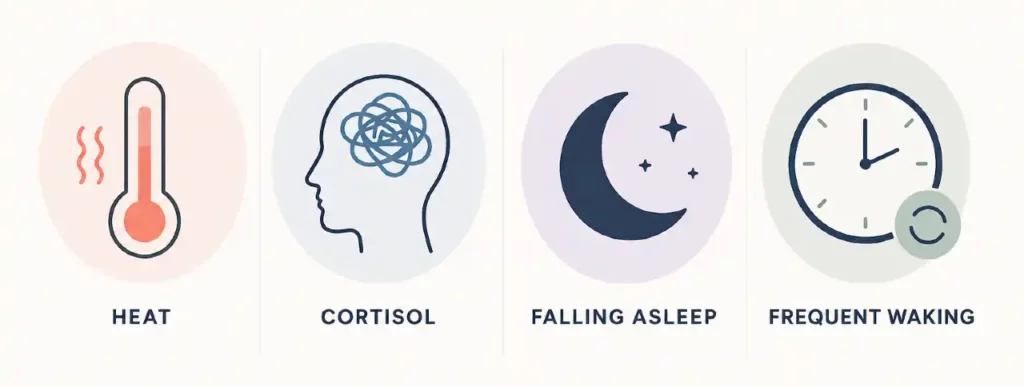
This is the part many articles miss: perimenopause sleep problems are not all caused by the same thing. Some women wake because they are overheating, some because cortisol spikes during the night, and some because the body simply struggles to stay in deep sleep.
Others have no trouble staying asleep but cannot fall asleep in the first place. Once you identify your main pattern, the right natural remedy becomes much easier to choose.
FAQs
How can I naturally improve sleep during perimenopause?
If you want to improve sleep during perimenopause naturally, the most effective place to start is usually with temperature control, nervous system support, blood sugar stability, and targeted supplements like magnesium or low-dose melatonin.
Why do I keep waking up at 3 AM during perimenopause?
This is often linked to cortisol spikes, blood sugar drops, overheating, or lighter hormone-related sleep architecture.
Is magnesium or melatonin better for perimenopause sleep?
Magnesium is often better for calming the body and reducing frequent waking, while melatonin is more helpful if falling asleep is the main problem.
Will sleep go back to normal after perimenopause?
For many women sleep improves again once hormones stabilize, but supportive habits and targeted supplements can make this transition much easier.
What Actually Helps Most
If you have been wondering how to improve sleep during perimenopause, it usually does not come from one dramatic fix. It comes from identifying what is disrupting your sleep most, whether that is overheating, nervous system tension, blood sugar dips, or difficulty falling asleep, and then choosing the right support for that pattern.
For many women, a few targeted natural changes make a much bigger difference than simply waiting for sleep to improve on its own.
Affiliate disclosure. Some links in this article may be affiliate links, which means we may earn a small commission at no extra cost to you. We only recommend products we believe are genuinely useful for perimenopause sleep support.