
It can be hard to know where to start when sleep changes during perimenopause.
You may feel tired, but still alert. You may fall asleep, but wake up again during the night. Or your body may feel tense even when you know you need rest.
Magnesium and melatonin are two of the most common supplements used for sleep, but they do very different things in the body.
So when it comes to magnesium vs melatonin for sleep, the best choice depends on what kind of sleep problem you’re dealing with.
In this guide, we’ll compare magnesium and melatonin for perimenopause sleep, including how they work, who they’re best for, and whether you can take them together.
If you’re still exploring your options, it can help to look at a broader overview of supplements for perimenopause sleep.
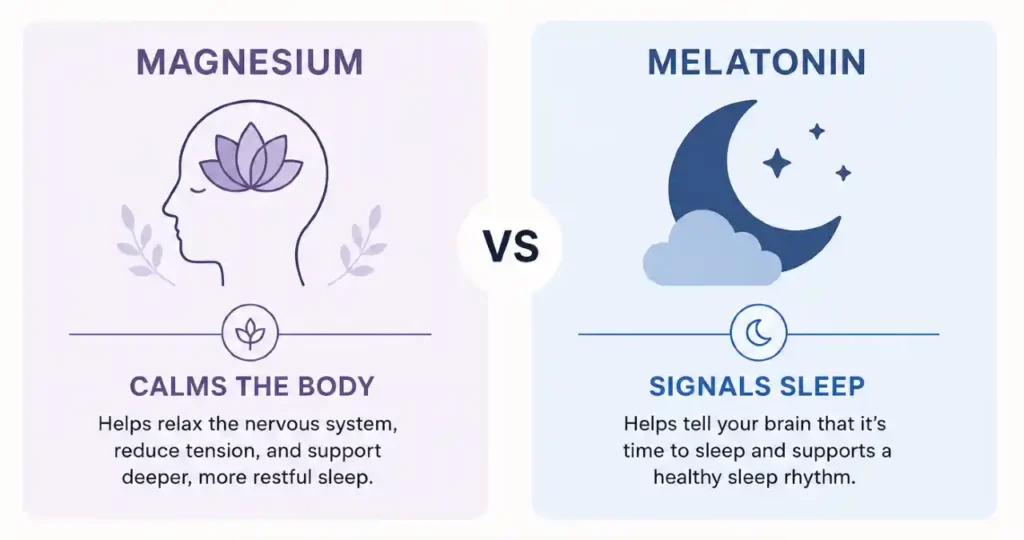
Quick answer: magnesium vs melatonin for sleep
Choose magnesium if your sleep issues are linked to stress, tension, anxiety, or feeling “wired but tired” at night.
Choose melatonin if you struggle to fall asleep, have an irregular sleep rhythm, or feel like your body no longer gets a clear sleep signal.
Consider both if you have trouble falling asleep and staying asleep, but it’s usually best to start with one and see how your body responds.
For product-specific recommendations, see our guides to the best magnesium for perimenopause sleep and the best melatonin for perimenopause sleep.
How magnesium helps with sleep
Magnesium is a mineral that helps support relaxation, muscle function, and nervous system balance.
During perimenopause, many women become more sensitive to stress. This can make it harder to wind down at night, even when you feel exhausted.
Magnesium may help by supporting the body’s calming systems and reducing physical tension. This makes it especially helpful if your sleep problems feel connected to stress, restlessness, or an overactive nervous system.
If you want to understand how much to take, see our guide on magnesium dosage for sleep during perimenopause.
- Supports nervous system relaxation
- May help reduce muscle tension
- Can support deeper, calmer sleep
- Often works best when taken consistently
We go deeper into this in our article on magnesium benefits for perimenopause.
How melatonin helps with sleep
Melatonin is a hormone your body naturally produces to signal that it’s time to sleep.
During perimenopause, hormonal changes can disrupt your natural sleep rhythm. This may make it harder to fall asleep at your usual time, or make your sleep feel lighter and less predictable.
Melatonin may help when the main problem is sleep timing. It doesn’t relax the body in the same way magnesium does. Instead, it helps send a clearer signal to the brain that it’s time to sleep.
- Helps signal sleep to the brain
- May help you fall asleep faster
- Can support a more stable sleep rhythm
- Works best when timed correctly before bed

If falling asleep is your main issue, read our guide to the best melatonin for perimenopause sleep.
Magnesium vs melatonin for sleep: key differences
| Feature | Magnesium | Melatonin |
|---|---|---|
| Main role | Helps calm the body | Signals sleep to the brain |
| Best for | Stress, tension, restlessness | Difficulty falling asleep |
| Works on | Nervous system and muscles | Sleep rhythm and circadian timing |
| When to take | Evening or daily | 30 to 60 minutes before bed |
| Best starting point if | You feel wired but tired | Your sleep schedule feels off |
Which one should you choose?
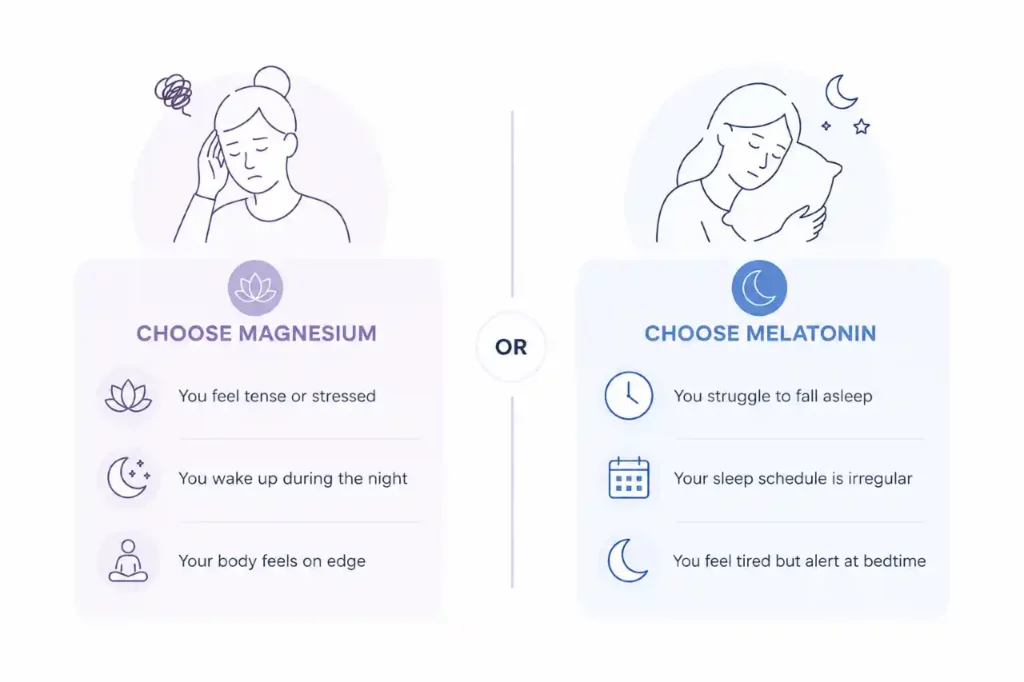
Choose magnesium if
- You feel tense or restless at night
- You wake up frequently
- Your body feels on edge
- You struggle to fully relax before bed
- Your sleep issues feel connected to stress or anxiety
Magnesium glycinate is often a good option for sleep because it is gentle and calming. You can compare options in our guide to the best magnesium glycinate for sleep.
Choose melatonin if
- You struggle to fall asleep
- Your sleep schedule feels irregular
- You feel tired but alert at bedtime
- You wake up because your sleep rhythm feels disrupted
- You want short-term support getting back into a routine
A lower dose is often a better place to start, especially if you are sensitive to supplements or want to avoid morning grogginess.
Can you take magnesium and melatonin together?
Yes, some people take magnesium and melatonin together.
This can make sense because they support sleep in different ways. Melatonin helps with the sleep signal, while magnesium helps the body relax.
For example, melatonin may help you fall asleep, while magnesium may help your body stay calmer through the night.
That said, you don’t always need both. If you’re not sure where to start, it’s usually better to choose the supplement that matches your main sleep issue first.
Common mistakes to avoid
- Taking too high a dose of melatonin
- Expecting magnesium to work instantly
- Choosing a supplement without matching it to your sleep pattern
- Ignoring lifestyle factors like caffeine, stress, evening light, and night sweats
If you want non-supplement strategies as well, read our guide on how to improve sleep during perimenopause naturally.
Magnesium vs melatonin FAQ
Is magnesium or melatonin better for perimenopause sleep?
It depends on your symptoms. Magnesium may be better if your sleep issues are linked to stress, tension, or restlessness. Melatonin may be better if you mainly struggle to fall asleep or your sleep rhythm feels disrupted.
Can I take magnesium every night?
Many people take magnesium daily, but it’s always best to check with a healthcare provider if you have a medical condition, take medication, or are unsure what dose is right for you.
Can melatonin make you groggy?
Yes, especially if the dose is too high. Many people do better with a lower dose, especially during perimenopause when sleep can feel more sensitive.
Which is better for waking up during the night?
It depends on why you’re waking up.
- If you wake up from stress, tension, or feeling unsettled, magnesium may be a better fit. This feeling is often linked to cortisol, which we explain in more detail here.
- If your sleep rhythm feels disrupted, an extended-release melatonin may be worth considering.
If you tend to wake up at the same time each night, you can read our guide on why you wake up at 3AM during perimenopause.
Should I start with magnesium or melatonin?
Start with your main sleep pattern. If your body feels tense or wired, magnesium is usually the better first step. If you simply can’t fall asleep, melatonin may be the better starting point.
Magnesium vs melatonin for sleep: which is better?
Magnesium and melatonin can both support sleep during perimenopause, but they solve different problems.
Magnesium is usually better for stress-related sleep issues, tension, and nervous system support. Melatonin is usually better for falling asleep and resetting your sleep rhythm.
The best choice is the one that matches your sleep pattern. If you feel wired but tired, start with magnesium. If you can’t fall asleep, start with melatonin. If both are happening, a careful combination may be helpful.
For more guidance, compare our guides to the best magnesium for perimenopause sleep and the best melatonin for perimenopause sleep.
Affiliate disclaimer
This article contains affiliate links. If you choose to purchase through these links, we may earn a small commission at no extra cost to you.